
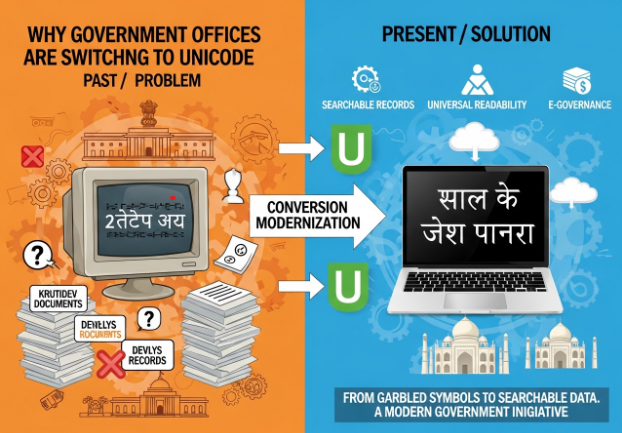
For decades, government offices across India relied on legacy Hindi fonts to create, store, and share official documents. Fonts like Krutidev, Mangal, and Devlys became deeply embedded in government workflows, from court filings and administrative orders to public notices and official correspondence. Millions of documents were created in these legacy systems, and entire generations of government typists were trained to use them.
But something significant has been shifting in recent years. Government departments at both the central and state levels have been actively moving away from legacy font systems and adopting Unicode as the standard for all Hindi digital communication. This transition is not happening by accident. It is driven by a clear set of practical, technical, and policy-level reasons that make Unicode the only sensible choice for modern government operations.
This article explores why this shift is happening, what problems it solves, and what it means for the future of Hindi in official digital systems.
The Problem with Legacy Fonts in Government
To understand why the switch to Unicode matters, it helps to first understand the problems that legacy fonts create in a government setting.
Documents Become Unreadable Without the Right Font
Legacy fonts like Krutidev work by mapping Hindi-looking characters to standard ASCII codes. A document created in Krutidev only displays correctly if the Krutidev font is installed on the computer reading it. In a government environment where documents are shared across dozens of departments, multiple states, courts, public portals, and citizen-facing services, this dependency creates constant problems.
A citizen accessing a government notice online may see nothing but garbled symbols if the required font is not installed on their device. A court receiving a document from another jurisdiction may not have the same font version installed. An archived record opened years later may be completely unreadable if the legacy font is no longer supported.
Search and Retrieval Fails
Government offices handle enormous volumes of documents. Being able to search through records quickly is essential for administrative efficiency, legal proceedings, and public information requests. Legacy font documents cannot be searched by their Hindi content because the underlying text is ASCII, not actual Devanagari characters. A search for a Hindi name or term returns nothing because the system does not recognize the text as Hindi at all.
Digital Integration Is Impossible
Modern e-governance systems, citizen portals, database management systems, and digital record-keeping platforms are all built on Unicode. When government data stored in legacy fonts needs to be integrated into these modern systems, it simply does not work. The text either appears broken or requires expensive, time-consuming manual conversion before it can be used.
Why Unicode Solves These Problems
Unicode addresses every one of these issues at the root level by storing actual Devanagari characters rather than ASCII substitutions.
Universal Readability
A document created in Unicode Hindi is readable on any device, any operating system, and any modern application without requiring any special font installation. Whether a citizen is accessing a government portal on a smartphone, a laptop, or a public computer, the text displays correctly every time.
Full Search Capability
Unicode text is recognized as real Hindi by every search engine, database, and document management system. Government records stored in Unicode can be searched, filtered, sorted, and retrieved by their actual Hindi content. This transforms the efficiency of record-keeping and information retrieval across departments.
Seamless Digital Integration
Because all modern software and e-governance platforms are built on Unicode, documents and data stored in Unicode integrate without friction. There is no conversion step needed, no compatibility issues to troubleshoot, and no risk of data corruption during transfer between systems.
Government Initiatives Driving the Switch
The transition to Unicode in Indian government offices is not just an organic technological shift. It has been actively supported and mandated by official policy at multiple levels.
The Department of Official Language
The Department of Official Language under the Ministry of Home Affairs has long advocated for the use of Unicode in government communications. Official guidelines issued over the years have encouraged central government departments to adopt Unicode-based Hindi fonts and move away from legacy systems for all digital correspondence and documentation.
National Informatics Centre
The National Informatics Centre, which provides technology infrastructure and support to government departments across India, has been a strong proponent of Unicode adoption. NIC-developed portals, databases, and e-governance applications are built on Unicode, and departments using these platforms are required to use Unicode-compatible Hindi input.
Court Systems and Legal Filings
Several High Courts and district courts across India have issued directives requiring legal documents and filings in Hindi to be submitted in Unicode format. This move has pushed lawyers, court staff, and litigants to transition away from legacy font documents, which were causing serious compatibility and readability issues in digital court management systems.
State Government Initiatives
Multiple state governments, including Uttar Pradesh, Madhya Pradesh, Rajasthan, and Bihar, have issued internal directives encouraging or requiring their departments to use Unicode for Hindi typing. State-level e-governance platforms in these states are built on Unicode, making the transition both necessary and supported.
The Role of Conversion Tools in the Transition
One of the biggest practical challenges in switching to Unicode is the enormous backlog of existing documents stored in legacy font formats. Government offices in India have accumulated decades worth of records in Krutidev, Mangal, and similar fonts. Retyping all of this content would be completely impractical.
This is where conversion tools play a critical role. A reliable Krutidev to Unicode converter can automatically transform legacy font text into proper Unicode Devanagari in seconds. Government departments can use such tools to batch-convert existing records, making their entire document archive searchable, portable, and compatible with modern systems without any manual retyping.
This ability to convert existing content quickly and accurately has been one of the key enablers of the broader government transition to Unicode, removing what might otherwise have been an insurmountable barrier to adoption.
Benefits Beyond Technical Compatibility
The switch to Unicode delivers benefits that go well beyond solving technical compatibility problems. It has meaningful implications for governance quality, citizen access, and the long-term preservation of official records.
Better Citizen Services
When government websites, portals, and notifications use Unicode Hindi, citizens can access official information on any device without needing to install fonts or use specialized software. This makes government services genuinely accessible to a much wider population, including people in rural areas using basic smartphones.
Improved Transparency and Accountability
Searchable, Unicode-based records make it easier for oversight bodies, journalists, researchers, and citizens to access and analyze government information. When records can be searched and retrieved accurately, accountability improves and the risk of important information being buried or lost is reduced.
Long-Term Archival Integrity
Unicode is an open international standard maintained by a global consortium of major technology organizations. It is not dependent on any single company or product. Government records stored in Unicode will remain accessible and readable for generations, regardless of changes in software or hardware. Legacy fonts, by contrast, are increasingly unsupported and at growing risk of becoming permanently unreadable as older systems are retired.
Support for Multilingual Governance
India is a linguistically diverse country, and many government offices work across multiple languages. Unicode supports virtually every script and language in the world within a single standard. Offices that handle documents in Hindi, Urdu, Tamil, Bengali, and other languages can manage all of them within a single Unicode-based system, simplifying workflows and reducing compatibility headaches.
Challenges Still Remaining
Despite significant progress, the transition to Unicode in government offices is not yet complete. Several challenges continue to slow adoption in certain areas.
Many older government employees were trained exclusively on legacy font systems like Krutidev and are comfortable with those tools. Retraining staff on Unicode-based keyboards and input methods requires time, resources, and institutional commitment.
Some departments have such large volumes of legacy documents that even with conversion tools, the task of migrating entire archives feels daunting. This is particularly true for courts and revenue departments with records going back several decades.
Awareness also remains uneven. While central government departments and larger state offices have generally moved forward with Unicode adoption, smaller district-level offices and local bodies in some states are still operating primarily on legacy systems.
Conclusion
The shift from legacy fonts to Unicode in Indian government offices is one of the most important and practical digital transitions happening in public administration today. It is driven by the simple reality that legacy systems are fundamentally incompatible with the demands of modern e-governance, digital communication, and long-term record keeping.
Unicode solves the core problems of portability, searchability, and digital integration in a way that legacy fonts never can. With strong support from central government policy, the National Informatics Centre, and court systems across the country, the direction is clear. Unicode is not just the future of Hindi in government. In many departments, it is already the present.
For offices and individuals still working with legacy font documents, the path forward is straightforward. Convert existing content to Unicode, adopt Unicode-based input tools, and take full advantage of the interoperability and reliability that the global standard provides.
