
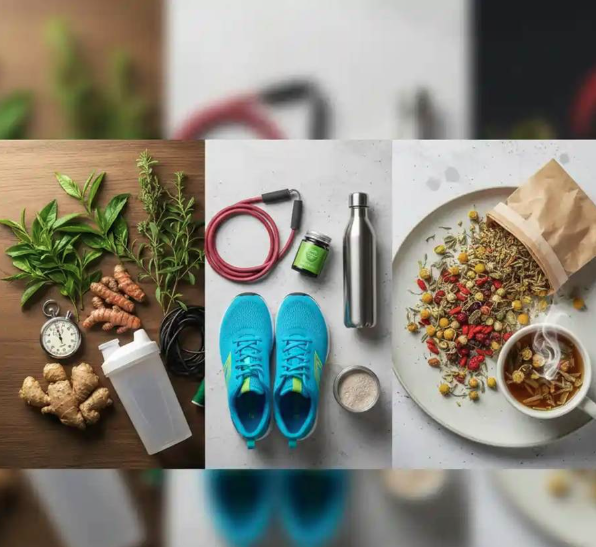
Herbs for athletes: what helps, what’s hype, and what’s risky
Herbs for athletes are everywhere—pre-workouts, “recovery” blends, adaptogens, and “natural performance” stacks. The problem is not that herbs can’t help. The problem is signal vs. noise: small studies, mixed products, and real risks (especially contamination and anti-doping violations).
This guide keeps it practical for beginners: which botanicals have the best evidence, what outcomes they may support (endurance, soreness, sleep, focus), and how to choose products with lower risk.
What do athletes actually need from herbs?
Herbs are add-ons, not foundations
Most performance gains come from training, sleep, adequate energy intake, hydration, and sport-specific carbs/protein timing. The best-case role for herbs is usually marginal support—for example, helping manage soreness, perceived exertion, or sleep quality.
Evidence quality varies by outcome
Herbal research is often strongest for:
- Recovery markers (muscle soreness, inflammation signals)
- Perceived fatigue / stress
- Small endurance changes in time-to-exhaustion tests
It’s typically weaker for:
- Large, consistent improvements in race performance
- Dramatic muscle gain claims
How common is supplement use and what are the real risks?
Stat block: supplement use is widespread
A 2022 review of athletes found reported supplement-use prevalence ranging from 11% to 100%, depending on sport, level, and how “supplement use” is defined.
A separate sport-science summary notes an overall prevalence around ~60% in an athlete-focused meta-analysis (with wide variation by population).
Stat block: contamination is not rare in “sports” products
In a 2025 Australian survey of 200 sports supplements, 35% contained at least one World Anti-Doping Agency prohibited substance and 57% of positive products did not list the prohibited ingredient on the label or website.
Independent research has also documented undeclared doping substances in high-risk sports supplements purchased online.
Anti-doping reality: strict liability
Under the strict liability principle, athletes are responsible for what is found in their body—intent doesn’t automatically protect you.
Bottom line: If you compete under testing rules, “natural” does not mean “safe for sport.”
Which herbs have the best evidence for performance?
Below are botanicals with human data relevant to athletic performance. Effects are usually small to moderate, and results depend on training status, dosing form, and study design.
Ashwagandha may support strength and aerobic capacity
A 2021 meta-analysis found Ashwagandha supplementation outperformed placebo for several physical performance variables.
A 2025 sports-focused systematic review/meta-analysis reported improvements across fitness outcomes and estimated a meaningful VO₂max increase in athletes (reported as ~4.09 ml/kg/min).
When it may fit: heavy training blocks, high stress, sleep-recovery emphasis.
Cautions: sedation in some people, potential interactions with certain conditions/medications; avoid “hormone-boosting” marketing claims.
Rhodiola rosea may improve endurance performance modestly
A 2025 meta-analysis evaluated endurance outcomes and biomarkers (oxidative stress, inflammation) and found overall signals of benefit, though study quality varies.
A 2022 review also reported improvements across performance-related outcomes in many studies, with limited adverse events reported.
When it may fit: endurance sessions, perceived exertion management.
Cautions: stimulant-like effects in some people; avoid combining with multiple stimulants.
Ginseng has mixed but suggestive evidence for endurance/fatigue
A 2022 systematic review suggested certain ginseng preparations/ginsenosides may improve endurance in healthy adults, but emphasized need for higher-quality trials.
A 2024 meta-analysis also found potential endurance benefits, with many studies still relying on non-human models or heterogeneous methods.
When it may fit: fatigue-prone phases, general vitality support.
Cautions: variable standardization; possible interactions (e.g., blood pressure, blood thinners).
Cordyceps (mushroom) shows early signals, not consensus
A controlled study using a Cordyceps militaris-containing blend reported improvements in VO₂max and time-to-exhaustion after a few weeks.
This is promising, but not yet “settled” across many large athlete trials.
When it may fit: endurance experimentation in off-season with careful tracking.
Cautions: product variability; contamination risk if sourcing is poor.
Which herbs are best supported for recovery and soreness?
Curcumin (from turmeric) may reduce soreness and muscle damage markers
A 2024 meta-analysis found curcumin supplementation reduced indicators associated with exercise-induced muscle damage (e.g., CK), soreness, inflammatory markers (e.g., IL-6), and helped range of motion in certain contexts.
In elite footballers, a curcumin-containing supplement attenuated post-match soreness and a biomarker of inflammation (CRP).
When it may fit: tournament congestion, high eccentric loads, return-to-training soreness.
Cautions: absorption depends on formulation; interaction potential with anticoagulants.
Ginger may modestly reduce DOMS in some settings
Clinical trial work and reviews suggest ginger can reduce exercise-related soreness in some protocols, though results are not universal.
When it may fit: soreness-prone athletes who tolerate ginger well.
Cautions: GI sensitivity; potential interactions with blood-thinning medications.
How do “herbs for athletes” compare to evidence-backed ergogenic aids?
Many athletes buy herbs expecting the kind of effects seen with well-studied aids like caffeine or creatine. That expectation is often unrealistic.
Reference point: A 2021 ISSN position stand reported caffeine has a small but significant effect on endurance performance, with average improvements in power output and time-trial completion in controlled studies.
For supplements overall, the International Olympic Committee consensus highlights that evidence and risk vary widely and decisions should be individualized and documented.
Takeaway: herbs can be supportive, but they rarely replace fundamentals or top-tier ergogenic strategies.
Table 1: Practical evidence map for common botanicals
| Botanical (common form) | Best-supported use-case | Evidence strength (for athletes) | Main risks / notes |
| Ashwagandha | Strength, VO₂max, stress/sleep support | Moderate | Product quality varies; monitor sedation |
| Rhodiola rosea | Endurance, fatigue perception | Low–Moderate | Can feel stimulating; watch stacking |
| Curcumin (turmeric extracts) | Recovery, soreness, inflammation markers | Moderate | Formulation matters; interaction potential |
| Ginger | DOMS/soreness support | Low–Moderate | GI tolerance varies |
| Panax ginseng | Fatigue/endurance in some studies | Low–Moderate | Standardization is a challenge |
| Cordyceps (mushroom) | Early endurance signals | Low | Blend effects; limited consensus |
How do you choose safer products if you compete?
Use third-party testing when anti-doping matters
Third-party certification can reduce (not eliminate) risk. For example, NSF’s Certified for Sport program describes testing to screen for banned substances and verify label accuracy.
U.S. Anti-Doping Agency explicitly recommends choosing third-party certified products to reduce the risk of adverse health effects or a positive test and notes no program can guarantee 100% safety.
Checklist: a low-routine way to decide if a herb is worth it
- Define one outcome (e.g., soreness after matches, sleep quality, perceived exertion).
- Pick one herb only (avoid “kitchen sink” blends at first).
- Verify standardization (named extract, consistent actives, transparent label).
- Check anti-doping risk level (high-risk categories: “fat burner,” “muscle builder,” stimulant-heavy pre-workouts).
- Prefer third-party certified lots if tested sport applies.
- Trial in training, not competition (track only 1–2 metrics for 2–3 weeks).
- Stop if side effects appear (sleep disruption, GI issues, palpitations, unusual anxiety).
Table 2: Anti-doping risk shortcuts
| Product type | Typical risk profile | Why |
| “Fat burners”, “hardcore pre-workouts” | High | Stimulants and undeclared substances appear frequently in surveys |
| Multi-ingredient “proprietary blends” | Medium–High | Harder to audit; higher adulteration incentives |
| Single-ingredient standardized herbs | Lower (not zero) | Easier to test/verify; still depends on manufacturer |
| Certified-for-sport lots | Lower (not zero) | Independent screening reduces risk |
FAQ
Are herbs legal for athletes under WADA rules?
Some are allowed, but legality depends on the final product and contamination risk. Strict liability still applies.
What’s the single most useful “herb-like” option for recovery?
Curcumin has relatively strong evidence for reducing soreness and muscle-damage-related markers in certain protocols.
Can ashwagandha improve VO₂max?
Systematic reviews/meta-analyses report improvements in cardiorespiratory fitness measures in some athlete populations, but results vary by study design and product.
Do third-party certifications guarantee you won’t test positive?
No. They reduce risk, but no testing program can cover every possible prohibited substance or every contamination scenario.
Are “natural boosters” safer than synthetic supplements?
Not automatically. Surveys show a meaningful fraction of sports supplements contain undeclared prohibited substances.
Glossary
- VO₂max — maximal oxygen uptake; a marker of aerobic capacity.
- DOMS — delayed onset muscle soreness after training.
- EIMD — exercise-induced muscle damage; includes soreness and strength loss.
- CK (Creatine Kinase) — blood marker often used as a proxy for muscle damage.
- IL-6 / CRP — inflammatory biomarkers commonly measured in recovery studies.
- Time-to-exhaustion — lab endurance outcome; can overstate real-world benefits.
- Strict liability — athletes are responsible for substances found in their body.
- Third-party testing — independent screening for banned substances/label accuracy.
Conclusion
If you’re exploring herbs for athletes, start with one goal, one ingredient, and low-risk sourcing. For most people, the smartest “performance stack” is still sleep + training + fueling—herbs are optional, and only worth it when you can measure a real benefit.
Sources
Daher J. et al. “Prevalence of Dietary Supplement Use among Athletes” (2022). https://pmc.ncbi.nlm.nih.gov/articles/PMC9570738/
Maughan RJ. et al. IOC Consensus Statement: “Dietary Supplements and the High-Performance Athlete” (2018). https://pubmed.ncbi.nlm.nih.gov/29589768/
Also hosted PDF: https://stillmed.olympics.com/media/Documents/Athletes/Medical-Scientific/Consensus-Statements/2018_dietary-supplements-high-performance-athlete.pdf
Guest NS. et al. ISSN Position Stand: Caffeine and Exercise Performance (2021). https://pmc.ncbi.nlm.nih.gov/articles/PMC7777221/
Bonilla DA. et al. “Effects of Ashwagandha on Physical Performance” (2021). https://pmc.ncbi.nlm.nih.gov/articles/PMC8006238/
Jayawardena R. et al. “Ashwagandha and sports performance” systematic review/meta-analysis (2025). https://journalofsportsmedicine.org/full-text/752/eng
Liu X. et al. Curcumin supplementation meta-analysis on exercise-induced muscle damage (2024). https://pmc.ncbi.nlm.nih.gov/articles/PMC11249235/
Clayton DJ. et al. Turmeric/curcumin-containing supplementation in elite footballers (2023). https://www.frontiersin.org/journals/nutrition/articles/10.3389/fnut.2023.1175622/full
Wang X. et al. Rhodiola rosea supplementation meta-analysis (2025). https://pmc.ncbi.nlm.nih.gov/articles/PMC12507841/
Ikeuchi S. et al. Panax ginseng / ginsenosides systematic review (2022). https://pmc.ncbi.nlm.nih.gov/articles/PMC8950061/
Hirsch KR. et al. Cordyceps militaris blend trial (2016). https://pmc.ncbi.nlm.nih.gov/articles/PMC5236007/
Sport Integrity Australia media statement: Sports supplements survey (2025). https://www.sportintegrity.gov.au/news/media-statements/2025-04/sport-supplements-survey
Barker L. et al. Sports Supplement Analysis Survey (2025, Drug Testing and Analysis – abstract). https://pubmed.ncbi.nlm.nih.gov/40180440/
Duiven E. et al. “Undeclared Doping Substances…” (2021). https://pmc.ncbi.nlm.nih.gov/articles/PMC8219275/
WADA World Anti-Doping Code (2021). https://www.wada-ama.org/sites/default/files/resources/files/2021_wada_code.pdf
USADA Supplement guidance (2019). https://www.usada.org/substances/supplement-connect/reduce-risk-testing-positive-experiencing-adverse-health-effects/
NSF Certified for Sport program description. https://www.nsf.org/consumer-resources/articles/certified-for-sport-program
AIS Sports Supplement Framework. https://www.ausport.gov.au/ais/nutrition/supplements
