

“I’d love to learn Python automation, but I don’t have time.” This is the most common reason professionals give for not starting. Between work demands, family responsibilities, and basic life maintenance, where does learning fit? The calendar is already full.
Yet some equally busy professionals complete automation Python courses while managing the same constraints. The difference isn’t having more hours — it’s using available hours strategically. This guide shows how, with specific tactics from professionals who’ve done it. Toronto-area learners can find local options in this guide to Python courses in Toronto.
The Time Reality Check
Let’s start with honesty about what’s required:
Minimum viable learning: 5-7 hours weekly for 10-12 weeks. Less than this, and skills don’t consolidate between sessions. You’re constantly re-learning instead of progressing.
Optimal learning: 8-12 hours weekly for 8-10 weeks. Faster progress, better retention, more practice time.
The math: Even minimum viable is 50-85 hours total. That time has to come from somewhere. Pretending otherwise sets up failure.
If you genuinely cannot find 5-7 hours weekly for 10-12 weeks, now isn’t the right time. Waiting for a less demanding period beats starting and abandoning. But if those hours exist somewhere in your week — even scattered — completion is possible.
Finding Hidden Time
Busy professionals who succeed find time in unexpected places:
The Commute Convert
The opportunity: Commuting time is often mentally idle. Transit riders can use phones or tablets for video lessons. Drivers can use audio content for concepts (not coding, but understanding).
The tactic: Download course videos for offline viewing. Listen to Python podcasts or concept explanations while driving. Convert dead time to learning time.
Realistic yield: 30-60 minutes daily for commuters. That’s 2.5-5 hours weekly without touching evenings or weekends.
The Lunch Learner
The opportunity: Lunch breaks are often underutilized — scrolling phones, casual conversation, eating at desks while working anyway.
The tactic: Dedicate 2-3 lunch breaks weekly to focused learning. Bring headphones. Find a quiet spot. 30-45 minutes of concentration.
Realistic yield: 1.5-2.5 hours weekly. Adds up significantly over months.
The Early Riser
The opportunity: Early morning, before household wakes and workday begins, offers distraction-free focus impossible at other times.
The tactic: Wake 45-60 minutes earlier on learning days. Protect this time absolutely — no email, no news, just course work.
Realistic yield: 3-5 hours weekly with 4-5 early sessions.
The Night Owl
The opportunity: Late evening after responsibilities end. The house is quiet. No one needs anything.
The tactic: Designate specific evenings for learning — not every night, but consistent nights. 8-10pm or whenever your household settles.
Realistic yield: 2-4 hours weekly with 2-3 evening sessions.
The Weekend Warrior
The opportunity: Weekends offer larger time blocks unavailable on weekdays.
The tactic: One significant weekend session — Saturday morning or Sunday afternoon. 2-3 hours of focused project work that needs concentration.
Realistic yield: 2-3 hours weekly, but higher quality for complex material.
The Micro-Learning Strategy
Traditional advice says “find a 2-hour block.” Busy professionals rarely have 2-hour blocks. Micro-learning works differently:
Concept learning: 15-20 minutes. Watch one video lesson, read one section. Absorb one concept per session.
Quick practice: 20-30 minutes. One exercise, one small challenge. Reinforce what you learned.
Deep practice: 45-90 minutes. Project work, complex problems, building real automations. Schedule these for your best available blocks.
The combination: Several micro-sessions during the week for concepts and quick practice. One or two longer sessions for deep work. Total time accumulates; skills build.
Why it works: Frequency matters more than session length for retention. Five 30-minute sessions beat one 2.5-hour session for most learning.
Protecting Your Learning Time
Found time disappears without protection:
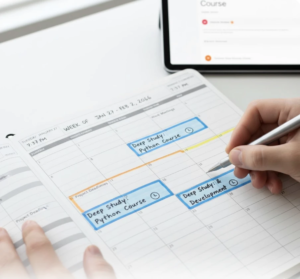
Calendar blocking. Put learning sessions on your calendar like meetings. Visible blocks get respected — by you and others.
Communication. Tell family or housemates when you’re learning. “I’m studying 7-8pm Tuesday and Thursday” sets expectations. Interruptions decrease when people know boundaries.
Environment switching. Learn somewhere different from where you relax. Kitchen table, home office, coffee shop, library. Location signals “learning mode” to your brain.
Phone discipline. Notifications destroy focus. Airplane mode during learning sessions. The world survives 45 minutes without reaching you.
Guilt management. Time spent learning isn’t stolen from other responsibilities — it’s invested in capability. Release guilt about “not working” or “not being available.” This time matters.
Course Format for Busy Schedules
Not all course formats suit time-constrained learners equally:
Self-paced online: Maximum flexibility. Learn at 6am or 11pm. Pause mid-lesson for interruptions. Resume anytime. Best for unpredictable schedules. Risk: requires self-discipline without external accountability.
Cohort-based with recordings: Scheduled live sessions create accountability, but recordings allow catching up when conflicts arise. Good balance of structure and flexibility.
Fixed-schedule live courses: Highest accountability but least flexibility. If you can protect the scheduled times, great. If your schedule is unpredictable, risky.
Intensive bootcamps: Require time blocks most busy professionals can’t provide. Usually better suited for career changers who can dedicate focused weeks.
Recommendation for busy learners: Self-paced or cohort-with-recordings. Flexibility is essential when schedules are demanding.
Progress Over Perfection
Busy learners must accept imperfection:
Some weeks will be worse. Work crises happen. Family needs arise. Missing sessions is inevitable. Plan for it. Don’t quit over bad weeks.
Slower is still progress. Taking 16 weeks instead of 10 still results in skills. Speed matters less than completion.
Minimum viable sessions count. Even 20 minutes maintains connection to material better than zero. On brutal days, do something — anything — to keep momentum.
Review reduces lost progress. Start sessions with 5 minutes reviewing previous material. Reconnect with where you left off. Reduces the “starting over” feeling after gaps.

The Busy Professional’s Advantage
Counterintuitively, being busy can help:
Efficiency mindset. You’re already skilled at using time well. That skill transfers to learning.
Clear motivation. Busy people don’t learn abstractly. You have specific automation targets — real tasks wasting your real time. That motivation sustains effort.
Immediate application. You’ll use skills at work immediately. Learning and applying happen together, reinforcing both.
Lower perfectionism. No time for perfect code or complete understanding of everything. You focus on what works, which is actually how practical skills develop.
Appreciation for automation. You know the value of saved time because you have none to waste. Automating a 3-hour task means 3 hours reclaimed. The ROI is visceral, not theoretical.
Sample Busy Professional Schedules
The Parent Professional (7 hours/week):
- Early morning before kids wake: 45 min × 3 days = 2.25 hrs
- Lunch breaks: 30 min × 3 days = 1.5 hrs
- Saturday morning during activities: 2 hrs
- Sunday evening after bedtime: 1.25 hrs
The Heavy Travel Professional (6 hours/week):
- Flight/airport time: 2-3 hrs per trip
- Hotel evening sessions: 1.5 hrs × 2 trips
- Home weekend catch-up: 2 hrs
The Long Commuter (8 hours/week):
- Train commute learning: 45 min × 5 days = 3.75 hrs
- Evening sessions: 1 hr × 2 days = 2 hrs
- Weekend project time: 2.25 hrs
None of these schedules require dramatic life changes. They optimize existing time differently.
When to Start
Waiting for the “perfect time” with abundant free hours means waiting forever. Life doesn’t create empty calendars for learning. But life does have:
- Slightly less demanding periods
- Upcoming schedule shifts
- Predictable slow seasons
- Moments when starting makes strategic sense
If a reasonable window exists in the next few months — not perfect, but workable — that’s your start point. Perfect conditions don’t exist for busy people. Workable conditions do.
The Investment Perspective
Here’s the irony: busy professionals who complete automation courses become less busy. The automations they build reclaim hours weekly. The time invested in learning returns multiplied.
Learning takes time you don’t have — to create time you desperately need. The short-term sacrifice enables long-term freedom. That’s not just time management philosophy; it’s the literal function of automation skills.
The busy professional who automates their reporting process saves 5 hours monthly — forever. The one who was too busy to learn keeps spending those hours manually — forever. Both were equally busy at the start.
For a course designed for working professionals — flexible pacing, practical focus, efficient curriculum — the LearnForge Python Automation Course fits learning into the time you actually have, not the time you wish you had.