
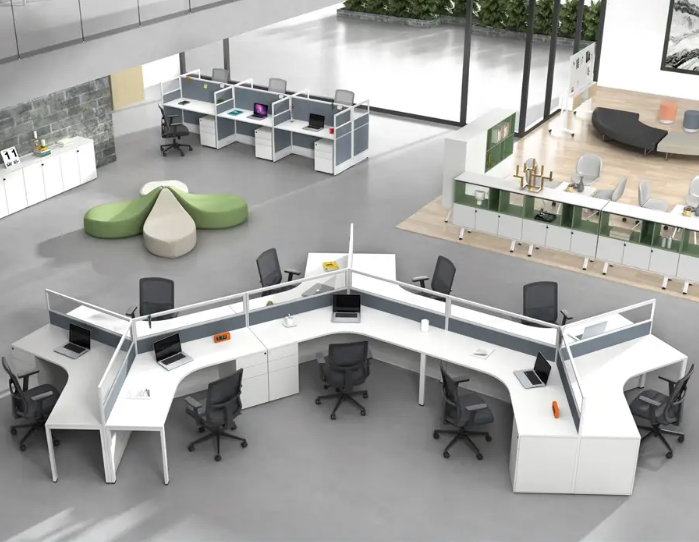
As today’s workplaces continue to evolve, businesses are moving away from rigid office layouts and embracing flexible, scalable workspace solutions. One of the most effective solutions transforming modern offices is the modular workstation. Designed to adapt to changing team sizes, workflows, and business goals, modular workstations offer unmatched versatility, cost efficiency, and ergonomic benefits.
Whether you operate a startup, a corporate office, a co-working space, or a call centre, modular workstations provide a future-proof foundation for productivity and growth.
What Is a Modular Workstation?
A modular workstation is a flexible office furniture system built from interchangeable components that can be arranged, expanded, or reconfigured as needed. Unlike traditional fixed desks, modular systems are designed to evolve with your business.
A typical modular workstation system includes:
- Modular desk surfaces
- Partition or privacy panels
- Storage units such as drawers and pedestals
- Cable management systems
- Integrated power and data access
- Monitor arms and office accessories
These independent modules allow businesses to redesign office layouts quickly without purchasing entirely new furniture.
Why Modular Workstations Are Essential for Modern Offices
Modern businesses must respond quickly to team expansion, remote work trends, and hybrid office models. A modular workstation offers a level of adaptability that traditional office furniture cannot match.
Key reasons why modular workstations are now the preferred choice include:
- Fast office reconfiguration
- Optimised space utilization
- Lower long-term furniture costs
- Support for team collaboration
- Better employee comfort and ergonomics
As companies seek flexibility and efficiency, modular workstations continue to replace fixed desks across industries.
Key Benefits of Modular Workstations
1. High Flexibility and Customisation
The strongest advantage of a modular workstation is its flexibility. Businesses can easily:
- Reconfigure desk layouts
- Add or remove workstations
- Build team clusters or private cubicles
- Adjust layouts for project-based teams
From single-user desks to large team benches, modular systems support unlimited configurations.
2. Scalable for Business Growth
As organisations grow, their workspace requirements change. With modular workstations:
- New employees can be accommodated quickly
- Existing layouts can be expanded without disruption
- Entire departments can be reconfigured at a low cost
This scalability makes modular workstations ideal for startups, fast-growing companies, and large enterprises.
3. Efficient Space Management
Space optimisation is critical in modern offices. Modular workstation layouts are designed to:
- Maximise seating capacity
- Reduce wasted floor space
- Improve traffic flow
- Support vertical storage
By using space more efficiently, businesses can lower rental costs while improving productivity.
4. Improved Collaboration and Productivity
Open modular workstation layouts encourage:
- Easier communication
- Faster teamwork
- Better knowledge sharing
- Improved company culture
At the same time, modular panels allow businesses to balance collaboration with privacy when needed.
5. Enhanced Ergonomics and Employee Comfort
Modern modular workstation designs focus on employee well-being with features such as:
- Height-adjustable desks
- Ergonomic seating compatibility
- Adjustable monitor arms
- Proper leg clearance and posture support
Comfortable employees experience reduced fatigue, fewer injuries, and higher overall productivity.
6. Easy Relocation and Reconfiguration
Unlike traditional office furniture, modular workstations are easy to:
- Dismantle
- Transport
- Reinstall
- Rearrange
This makes them ideal for businesses that relocate offices or frequently reorganise departments.
Types of Modular Workstations
1. Single Modular Workstations
Designed for individual users, these are widely used in:
- Administrative offices
- Design studios
- Software development teams
They offer personal storage, privacy panels, and ergonomic desk configurations.
2. Multi-Person Modular Workstations
These include popular layouts such as:
- 2-person workstation
- 4-person workstation
- 6-person and 8-person bench systems
Multi-user setups are ideal for sales teams, call centres, and shared office environments.
3. Open-Plan Modular Workstations
Open modular layouts feature shared desk systems with minimal partitions. They promote:
- Collaboration
- Transparency
- Modern office aesthetics
These are commonly used in tech companies, marketing agencies, and co-working spaces.
4. Cubicle Modular Workstations
Cubicle-style modular workstations use higher partitions to provide:
- Better noise control
- Visual privacy
- Individual focus
They are preferred in finance, HR, and administrative departments.
5. Height-Adjustable Modular Workstations
These systems allow users to switch between sitting and standing positions, improving:
- Circulation
- Energy levels
- Long-term spinal health
Sit-stand modular workstations are becoming a standard in health-conscious workplaces.
Materials Used in Modular Workstations
The durability and appearance of a modular workstation depend heavily on material quality. Common materials include:
- Steel frames for high load-bearing strength
- Aluminium structures for lightweight durability
- MDF or particleboard desktops with laminate finishes
- Fabric or acoustic panels for noise control
- Tempered glass panels for modern office designs
High-quality materials ensure longer service life and reduced maintenance.
Applications of Modular Workstations
Modular workstation systems are used across multiple industries, including:
- Corporate offices – for management, finance, and administrative teams
- IT and software companies – for developers and engineers
- Call centres and BPOs – for dense, high-efficiency work environments
- Co-working spaces – for flexible hot-desking and shared offices
- Educational institutions – in computer labs and training centres
- Industrial offices – in control rooms and design departments
Their adaptability makes modular workstations suitable for virtually any professional setting.
Custom Modular Workstation Design
One of the key advantages of modular office systems is full customisation. Businesses can customise:
- Desk dimensions
- Panel heights and finishes
- Storage configuration
- Power and data socket placement
- Cable management systems
- Colour schemes and branding
A customised modular workstation design ensures optimal alignment with workflow, branding, and space usage.
Cost of Modular Workstations
The cost of modular workstations depends on several factors:
- Number of users
- Desk size and layout
- Material selection
- Storage and electrical features
- Customisation level
While the initial investment may be higher than traditional desks, modular workstations deliver better long-term value due to:
- Reusability
- Scalability
- Lower relocation costs
- Minimal replacement needs
Over time, they offer a much lower total cost of ownership.
Installation and Maintenance
Installation Benefits:
- Fast setup
- Minimal workplace disruption
- Clean and organised assembly
Maintenance Requirements:
- Regular surface cleaning
- Panel inspection
- Electrical safety checks
- Cable management upkeep
Modular workstations are designed for low maintenance and long-term reliability.
Sustainable Advantages of Modular Workstations
Modern businesses are increasingly focused on sustainability. Modular workstation systems support eco-friendly practices by:
- Reducing furniture waste
- Using recycled and low-emission materials
- Extending furniture life cycles
- Supporting green building standards
This makes modular workstations ideal for ESG-focused organisations.
Modular Workstation vs Traditional Office Furniture
Compared to traditional desks, modular workstations offer:
- Greater flexibility
- Better scalability
- Easier relocation
- Higher space efficiency
- Stronger long-term cost savings
Traditional desks lack the adaptability required in today’s fast-changing business environment.
Conclusion
The modular workstation is no longer just an office furniture trend—it is a strategic business solution. Its flexibility, scalability, ergonomic benefits, and cost efficiency make it the ideal choice for modern workplaces of all sizes.
From startups to global enterprises, modular workstation systems support productivity, collaboration, and long-term growth while maximising the value of office space. With custom design options, durable materials, and sustainable benefits, modular workstations provide a future-ready foundation for the evolving world of work.
If your business is planning an office renovation, expansion, or new workspace setup, investing in a high-quality modular workstation system is one of the smartest decisions you can make.